







Breaking Down Barriers: George McLaurin and the Struggle to End Segregated Education
Breaking Down Barriers: George McLaurin and the Struggle to End Segregated Education
For nearly sixty years, the University of Oklahoma, in obedience to state law, denied admission to African Americans. Only in October 1948 did this racial barrier start to break down, when an elderly teacher named George McLaurin became the first African American to enroll at the university. McLaurin's case, championed by the NAACP, drew national attention and culminated in a U.S. Supreme Court decision. In Breaking Down Barriers, distinguished historian David W. Levy chronicles the historically significant--and at times poignant--story of McLaurin's two-year struggle to secure his rights.
Through exhaustive research, Levy has uncovered as much as we can know about George McLaurin (1887-1968), a notably private person. A veteran educator, he was fully qualified for admission as a graduate student in the university's School of Education. When the university denied his application, solely on the basis of race, McLaurin received immediate assistance from the NAACP and its lead attorney Thurgood Marshall, who brilliantly defended his case in state and federal courts.
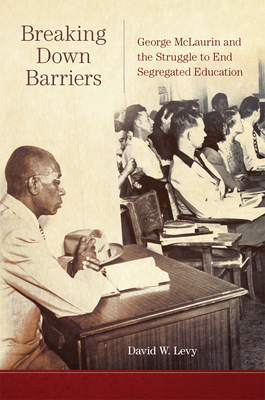
On his very first day of class, as Levy details, McLaurin had to sit in a special alcove, separate from the white students in the classroom. Photographs of McLaurin in this humiliating position set off a firestorm of national outrage. Dozens of other African American men and women followed McLaurin to the university, and Levy reviews the many bizarre contortions that university officials had to perform, often against their own inclinations, to accord with the state's mandate to keep black and white students apart in classrooms, the library, cafeterias and dormitories, and the football stadium.
Ultimately, in 1950, the U.S. Supreme Court, swayed by the arguments of Marshall and his co-counsel Robert Carter, ruled in McLaurin's favor. The decision, as Levy explains, stopped short of toppling the decades-old doctrine of "separate but equal." But the case led directly to the 1954 landmark decision in Brown v. Board of Education, which finally declared that flawed policy unconstitutional.
PRP: 154.69 Lei

Acesta este Prețul Recomandat de Producător. Prețul de vânzare al produsului este afișat mai jos.
123.75Lei
123.75Lei
154.69 LeiPrimești 123 puncte
Indisponibil
Descrierea produsului
For nearly sixty years, the University of Oklahoma, in obedience to state law, denied admission to African Americans. Only in October 1948 did this racial barrier start to break down, when an elderly teacher named George McLaurin became the first African American to enroll at the university. McLaurin's case, championed by the NAACP, drew national attention and culminated in a U.S. Supreme Court decision. In Breaking Down Barriers, distinguished historian David W. Levy chronicles the historically significant--and at times poignant--story of McLaurin's two-year struggle to secure his rights.
Through exhaustive research, Levy has uncovered as much as we can know about George McLaurin (1887-1968), a notably private person. A veteran educator, he was fully qualified for admission as a graduate student in the university's School of Education. When the university denied his application, solely on the basis of race, McLaurin received immediate assistance from the NAACP and its lead attorney Thurgood Marshall, who brilliantly defended his case in state and federal courts.
On his very first day of class, as Levy details, McLaurin had to sit in a special alcove, separate from the white students in the classroom. Photographs of McLaurin in this humiliating position set off a firestorm of national outrage. Dozens of other African American men and women followed McLaurin to the university, and Levy reviews the many bizarre contortions that university officials had to perform, often against their own inclinations, to accord with the state's mandate to keep black and white students apart in classrooms, the library, cafeterias and dormitories, and the football stadium.
Ultimately, in 1950, the U.S. Supreme Court, swayed by the arguments of Marshall and his co-counsel Robert Carter, ruled in McLaurin's favor. The decision, as Levy explains, stopped short of toppling the decades-old doctrine of "separate but equal." But the case led directly to the 1954 landmark decision in Brown v. Board of Education, which finally declared that flawed policy unconstitutional.
Detaliile produsului



